Colombia
Cartagena on Colombia’s northern Caribbean coast is a vibrant coastal city known for its well-preserved colonial architecture, historic walled city and beautiful beaches which is reflected in their music, food, architecture and historical sites. Much of Cartagena’s beauty lies inside the old city walls called Las Murallas, these thick concrete walls, considered the most complete set of fortifications in South America, were built to protect Cartagena from its former pirate enemies and wild storms.
One of the most beautiful Spanish colonial cities in Latin America, Cartagena’s old town is a World Heritage Site founded in 1533 by Pedro Heredia. There are three districts in Cartagena’s old town: El Centro, San Diego and Getsemani all wonderful areas to wander around exploring the cobblestone streets, relaxing in the beautiful plazas and admiring the perfectly preserved colonial architecture of the city formerly known as Cartagena de Indias.
Cartagena’s old colonial walled city on the Caribbean coast is a maze of colourful narrow streets, plazas, flower-filled ornate balconies, bright colours, arches, facades, shady patios, door knockers, intricate carvings, large wooden doors used by carriages, century old churches, modest houses and mansions adorned with overhanging balconies of all shades and sizes, colourful fruit ladies, street stalls, markets, lizards that represented royalty signifying a family’s Royal Spanish background is something to be enjoyed.
La Torre del Reloj is the main entrance to the historic centre of Cartagena. Built in 1601, initially called Boca del Puente was built to connect, via a drawbridge Getsemani with old Cartagena becoming the main entrance to the city when the walled enclosure was completed. It once contained a chapel and weapons room, the tower was rebuilt in the 1800s resulting in an eight-sided goth construction housing a pendulum clock later replaced with a Swiss clock.
Cartagena’s Walled City includes several charming squares which are wonderful places to spend time, each with its own unique character and focal points for historical exploration and modern day life within the cities historical centre.
CARRIAGE SQUARE Plaza de los Coches
Known for its horse-drawn carriages formally and as the Square of Judges where slaves were once sold and carriages kept.
Is near the main gate of the Clock Tower and was named because the mayor allowed cars to park in front of the numerous sweet shops that lined the edge of the square, also known as the Square of Cars of Portal de los Dulces.
COLONIAL SQUARE Plaza de San Diego
The plaza is a favourite among students who mostly train as artists in the institutions located here along with the legendary hotel Santa Clara, the 16th century convent. Sitting on a bench, under the shade of the large tree you can see the street food stalls and students gather to practice what they have learnt in the classroom.
One of Cartagena’s best-preserved historical sites, a previous salves’s market, the square has witnessed centuries of change.
CUSTOMS HOUSE SQUARE Plaza de La Aduana
Is the largest and oldest square in the historic centre bordered on one side by the imposing city walls, at the centre of the square is a statue of Christopher Columbus alongside an indigenous woman.
The principal building overlooking the square is the old colonial customs house where the founder of Cartagena, Don Pedro de Heredia once lived.
The Old Customs House served as a crucial administrative centre during colonial times. Today the building has been beautifully restored and functions as the City Hall, the Alcaldia Mayor de Cartagena de Indias.
Named after the Colombian saint know as the Patron Saint of Slaves is where the dominant architectural feature of the square is the huge church which also bears Claver’s name.
CHURCH of SAINT PETER CLAVER Santuario Museo San Pedro Claver
Also know as the Cathedral of Cartagena was built between 1580 and 1654 in the Spanish colonial style by order of King Ferdinand VI of Spain. The Colombian Catholic church is dedicated to Saint Peter Claver, a Jesuit priest who spent his life helping the black slaves brought from Africa by Spanish colonists and is the Patron Saint of Colombia.
MUSEUM of INQUISITION Museum of Cartagena de Indias
Established in 1984, the beautifully restored 18th-century colonial mansion served as the headquarters of the Spanish Inquisition in Cartagena during the colonial period and is the same palace where tortures were carried out serving as a reminder of the complex and often troubling legacies of colonialism and religious persecution in the region.
King Philip III was in charge of establishing the Tribunal of the Inquisition in 1610 functioning until 1821, when Colombia was consolidated as a country.
The exhibitions include indigenous cultures of the region, the impact of colonialism, the history of slavery and the African diaspora and the cities role in the struggle for independence.
SAN FELEPE DE BARAJAS CASTLE Castillo San Felipe de Barajas
Overlooking the Old Town the fortress was commissioned in 1630 to defend the city from pirates and enemy invasions. Located on the Hill of San Lázaro it was built by African slave labour and was involved in several battles between the late 17th to 19th centuries.
The Spanish Crown began the work of fortifying Cartagena in the second half of the 16th century when the first forts, trenches, ditches and palisades were built. Subsequently, by order of King Phillip ll, the fortification of the Caribbean ports were based on a plan of 1594, the first walls were constructed of wood, kindling sticks and compacted earth beginning in 1597; and in stone, beginning in 1614 and always under the direction of military engineers with manual labor of artisans, prisoners and slaves.
In 1656, to deal with a possible English attack, Governor Pedra Zapata began the construction of the San Felipe Fortress, named to render tribute to King Philip lV and the ancestors of the governor, the Counts of Barajas.
In 1697 Cartagena was attached by the French who accompanied by freebooters entered through Bocachica and subsequently the city was taken. The damage caused by the attack was repaired and the San Felipe Castle was reinforced with collateral protection.
In 1741, Cartagena was attacked by the English, the enemy took the fortresses of the bay and its navy entered, but the siege was decided at the San Felipe Castle where the English were defeated. The was the last of the attempts to take Cartagena on the part of European powers.
Between 1762 and 1769 the collateral batteries of La Redención, La Cruz, El Hornabeque, San Carios and the Apostles, Santa Bábara and San Lázaro were built with a capacity for 62 canons, cisterns, sentry boxes, ramps and a comples system of tunnels.
There is a complex system of tunnels connecting strategic points to allow provisions to be distributed and to facilitate evacuation. The tunnels were constructed so that any noise reverberated all the way along them, making it possible to hear the slightest sound of an approaching enemy’s feet and also making internal communication easy.
Once Cartagena became independent, in 1821, the fortresses lost relevance and fell into neglect. After being in private hands it was returned to the nation and the recovery of the fortress began. The Ministry of Culture designated the Escue-la-Taller, Cartagena de Indias as the entity responsible for the protection, restoration, conservation and recognition of the value of the city’s fortifications. The totality of theresources contributed by visitors in entrance fees is reinvested in their maintenance.
COLOMBIAN NATIONAL AVIARY Aviario Nacional de Colombia
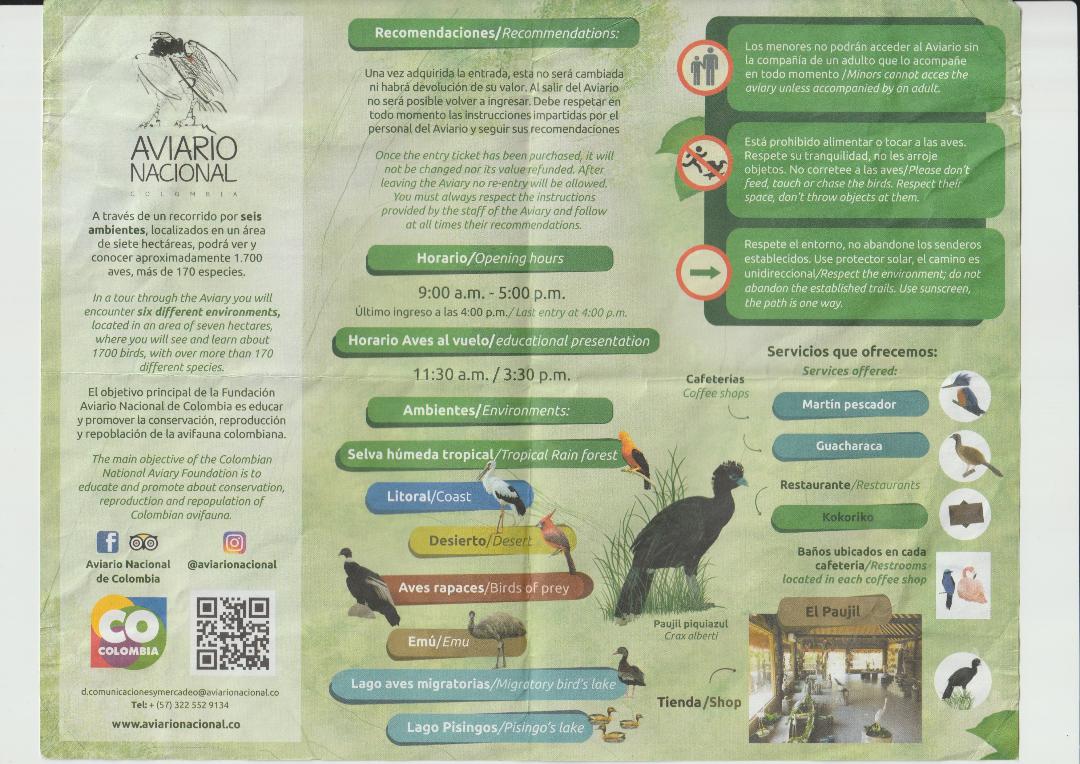
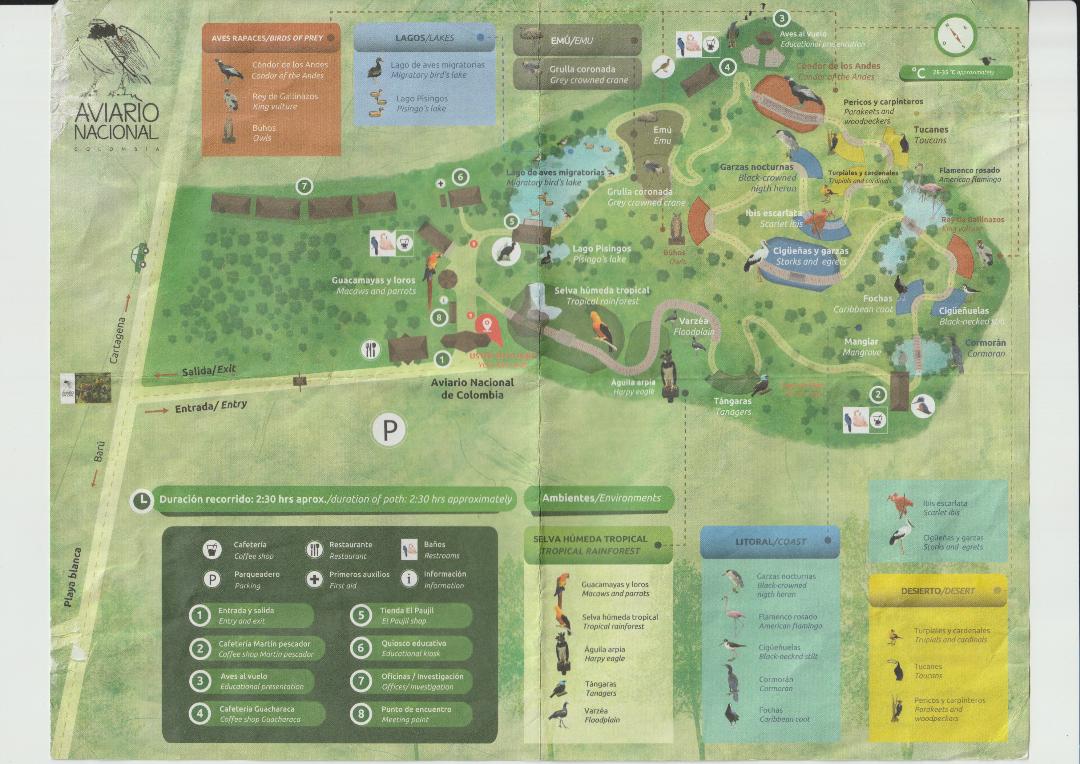
A modern conservation representation of avifauna on Barú Island the aviary is set in seven hectares of natural habitat where over 2000 birds including the Harpy Eagle, the toucan Caribbean, Pink Flamingos and Crane Corona where over a 190 species native to Colombia and other parts of Latin America can be observed. There are various walking trails, 3 different eco systems (rainforest, coast and desert) and 21 varied exhibitions.
Try perfectly cooked ceviche, monkfish and laing. Good coconut pie, cheesecakes and flans have an appetizing taste. According to the reviewers’ opinions, waiters offer delicious wine, margaritas or fino sherry. Choose great cortado, you won’t regret it. The fine service is something these restaurateurs care about.
 Therese O'Leary